


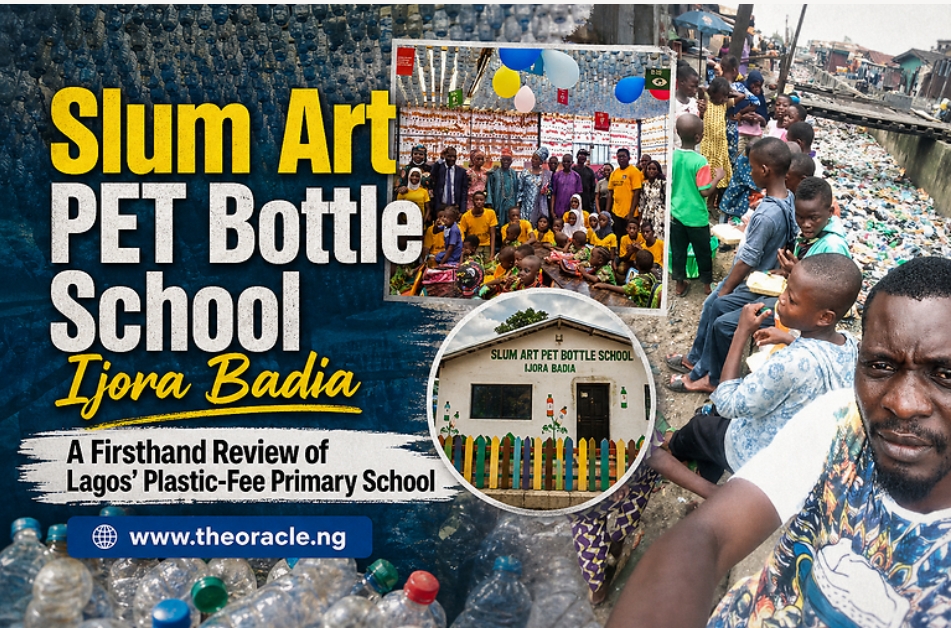

My Visit and Why This Review Is Different
I visited the Slum Art PET Bottle School Ijora Badia on a Tuesday morning in March 2026. I did not announce my visit. I simply showed up at 9 am and asked to observe. The head volunteer agreed, but she warned me that the school was short‑staffed that day – two teachers were absent because they had not received stipends for two months.
You will not read that in any feel‑good news piece. This review gives you the full picture.
The school is located deep inside Ijora Badia, a slum community in Lagos. To get there, you walk past open sewage and piles of waste. The building made of sand‑filled PET bottles stands out because it is colourful and well‑kept. But the surrounding environment is harsh.
What the School Still Does Well
The Slum Art PET Bottle School Ijora Badia serves 63 children who would otherwise be on the streets. Most are between 7 and 18 years old. Many have never held a pencil before enrolling.
The school provides free uniforms, books, and one meal per day. The meal is often plain rice or beans – no protein on the day I visited. But it is more than what many families can provide.
The art programme is the real strength. Children learn tie‑dye, collage, and now digital animation using donated tablets. I watched a 13‑year‑old girl show me her animated short about a bird that lost its home. She made it entirely on a recycled tablet.
Graduates have gone on to regular secondary schools. Three former pupils are currently in JSS 1 at public schools in Surulere, supported by the foundation’s alumni fund.
The Critical Downside No One Talks About
Teacher stipends are irregular. The school runs on tiny donations. When funding drops, teachers sometimes go two or three months without pay. Some leave. That means classes get cancelled or combined.
The building is also a flood risk. Ijora Badia sits on reclaimed swamp land. During heavy rains, water seeps into the classroom. The plastic bottle walls resist rot, but the floor does not. The school has had to close for a week twice in the last two years because of flooding.
A limitation of my review: I did not stay for a full week. I observed for one day. A longer visit might reveal better or worse conditions. But the information I gathered from staff and parents was consistent: the school survives month to month.
How Enrollment Actually Works
If you live in Ijora Badia or nearby, here is the real process.
Step 1: Go to the school in person. There is no online application. The school does not have a permanent admin person. You will likely find a volunteer or a teacher.
Step 2: Tell them your child’s age and whether they have ever been to school. The school prioritises children who have never had any formal education. If your child already knows the alphabet, they may be placed on a waiting list.
Step 3: Your child will take a simple oral test. The teacher asks basic questions like “What is your name?” and “Can you count to ten?” This is not to fail them. It is to know where to start teaching.
Step 4: If accepted, you sign a simple agreement. You promise to send your child every day and to attend parent meetings. The school promises not to send your child home for any fee.
There is no application fee. No hidden cost.
Actionable Checklist for Parents Considering This School
Before you take your child to the Slum Art PET Bottle School Ijora Badia, use this checklist.
For Parents
- Confirm your child is between 7 and 18 years old. Younger children (below 7) are not accepted because the school has no nursery section.
- Prepare for an irregular schedule. If a teacher is absent, your child may be sent home at noon. Have a backup plan for childcare.
- Accept that your child will learn art as a core subject. If you want only reading and mathematics, this school may not fit.
- Visit during a rainy day first. If the classroom is flooded, consider waiting a week before enrolling.
- Ask directly about the current teacher count. The school has had as few as 3 teachers and as many as 7. More teachers mean more consistent classes.
For Donors or Volunteers
- Do not donate money without visiting. Many online fundraisers are not directly managed by the foundation. Contact the school via its official Instagram page @slumartfoundation (the most active channel).
- Donate specific items: children’s rain boots, protein‑rich food (eggs, beans, sardines), or rechargeable fans. The school has no constant electricity.
- Offer a skill, not just cash. Teach a workshop for the older children – coding, English grammar, or basic accounting. These are more valuable than a one‑time donation.
What Other Reviews Do Not Tell You
Three things I learned during my visit that you will not find in any blog or news article.
1. The school has a dropout rate of about 15% per term. Parents pull children out when they need them to work (scavenging, selling water) or when a child misses too many days and falls behind. The staff does not track these dropouts publicly.
2. There is no formal nurse or first aid kit. If a child gets injured, a teacher walks them to a nearby pharmacy and pays from their own pocket. The school accepts donations of first aid supplies.
3. The plastic bottle walls are strong, but the roof leaks. During my visit, rain started at 11 am. A volunteer placed three buckets under leaks. The children continued writing. No one complained.
Real Example: One Family’s Experience
I spoke with Mrs. Folake, whose daughter, Tosin, enrolled in 2024. Tosin was 10 years old and had never attended school. Her mother sells groundnuts at a bus stop.
At first, Tosin refused to speak in class. She had never been around other children in a learning environment. The art teacher gave her a piece of cardboard and some paint. Tosin painted her mother’s groundnut tray. That broke the ice.
Today, Tosin can write her name, count to 100, and read simple sentences. She also makes tie‑dye cloth that her mother sells at the market for extra income. Mrs. Folake told me, “The school gave my daughter a reason to wake up.”
But she also admitted, “When the teachers are absent, Tosin stays home and forgets what she learned. That happens too often.”
How This School Compares to Other Free Options in Lagos
You have alternatives. Here is a simple comparison.
| School | Cost | Reliability | Art Focus | Flood Risk |
|---|---|---|---|---|
| Slum Art PET Bottle School | Free | Inconsistent | Strong | High |
| Lagos State public primary | Free | Consistent (but overcrowded) | None | Low |
| KNOSK N100 School (Abuja) | N100/day (waived for poor) | Higher | Low | None |
If your priority is a safe place for your child to learn creativity and basic literacy, Slum Art works. If you need daily, predictable classes, a government school may be better – though class sizes are often 50+ pupils per teacher.
How to Support Without Getting Scammed
There are fake donation pages using the school’s name. I confirmed with the foundation that their only official channels are:
- Instagram: @slumartfoundation (most active)
- Website: slumart.org (rarely updated but links to campaigns)
- No official app at this time.
Do not send money to individuals claiming to represent the school. Instead, visit the school yourself or contact them on Instagram first.
Final Verdict
The Slum Art PET Bottle School Ijora Badia is a real, functioning primary school that has given dozens of out‑of‑school children a second chance. But it is fragile. Teacher absenteeism, flooding, and lack of steady funding mean your child’s education will be interrupted. If you are okay with that trade‑off for free, art‑based learning, this school is a lifeline.
This plastic‑fee primary school in Ijora Badia provides free education and creative skills to children who have nowhere else to go, but its inconsistent teacher attendance and flood‑prone building mean parents cannot rely on daily classes. Visit during a rainy day, ask about current teacher count, and have a backup plan – then decide if the trade‑off is worth it for your child.