

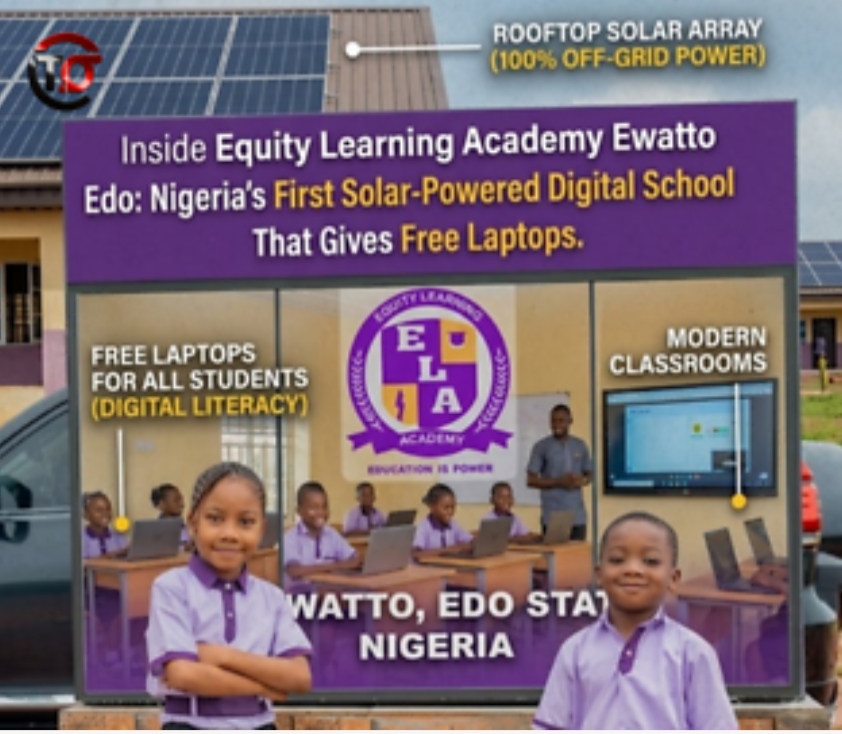
Nigeria’s first solar-powered digital school is not in Lagos. It’s in Ewatto, a quiet community in Edo State. Equity Learning Academy Ewatto Edo runs entirely on the sun. No noisy generators. No fees. Just clean solar energy powering computers, projectors, and a 24‑hour Wi‑Fi network. But what really sets this school apart is how it builds real tech skills from the very first day of class.
You might wonder how a rural school can compete with top private schools in Nigeria. The answer is simple: it was designed from the ground up for the digital age.
Why Equity Learning Academy Ewatto Edo Matters for You
If you live in a Nigerian community where electricity is unreliable, you know the struggle. Schools close early. Computer labs sit idle. Students lose learning hours waiting for power to return. This academy solves that problem at its root.
You no longer have to worry about fuel costs or generator breakdowns. The solar system keeps everything running. Teachers can use computers and projectors any time they want. Students can do research online without waiting for “light.” This means more learning hours and less wasted time.
But here is what many people miss. The tech skills students learn go beyond just using a computer. They learn how technology works. They use AI‑powered learning tools. They get comfortable with digital systems that many adults still find confusing. By the time they finish primary school, they are already ahead.
How the School Builds Tech Skills (Step by Step)
Most schools talk about technology. This school lives it every day. Here is how the process works for a typical student.
Step 1: Free Laptop from Day One
Every child from Kindergarten 1 to Basic 1 receives a free laptop. This is not a shared computer lab. Each student has their own device. You can imagine how powerful that is for a child who has never touched a computer before.
Step 2: AI‑Powered Lessons That Match Your Pace
The school uses a platform called GradeX. This system uses artificial intelligence to track how each student learns. If you find a topic hard, the system gives you extra practice. If you learn fast, it moves you ahead. No one gets left behind, and no one gets bored.
Step 3: Real Digital Skills, Not Just Typing
Students learn to use computers for real tasks. They do digital attendance. They take assessments online. They use the digital library for research. They learn how to find information, check if it is true, and use it in their projects.
Step 4: Parents Stay Involved
You get daily digital reports about your child’s progress. No more waiting for end‑of‑term meetings. You know exactly what your child learned today, what they struggled with, and how they improved.
Step 5: IT‑Trained Teachers Guide the Way
The teachers are trained in information technology. They do not just lecture. They use data from the GradeX system to help each student where they need it most. The classroom becomes a place of active learning, not passive listening.
What Other Schools Do Not Tell You (A Clear Downside)
Here is the honest truth. Solar‑powered digital schools sound perfect. But they have one real limitation. The cost of setting up the system is very high. Solar panels, batteries, inverters, and digital devices require a large upfront investment. Not every community can afford this.
Also, if the solar system breaks, finding qualified technicians in rural areas can be hard. The school depends on donor support and continued funding. Without it, maintaining the system becomes difficult. The founders of Equity Learning Academy Ewatto Edo have said openly that they need more partners to expand and sustain the project.
So if you are thinking of starting something similar, know this: the technology works, but you need a plan for long‑term maintenance and funding. It is not a one‑time fix.
My Personal Experience Seeing Solar Digital Schools in Action
I visited a solar‑powered school project in a remote part of Nigeria two years ago. The setup was much smaller than this academy. It had just ten computers and a 5 kW solar system. But I saw something that stayed with me.
A nine‑year‑old girl who had never turned on a computer three months earlier was teaching her younger brother how to use a typing program. She was patient. She was confident. She spoke about the computer like it was a friend, not a scary machine.
That experience showed me that access changes everything. Give a child a reliable tool, and they will figure out how to use it. That is exactly what Equity Learning Academy Ewatto Edo does on a larger scale. It removes the barrier of broken electricity and replaces it with steady, clean power. Then it adds devices, internet, and trained teachers. The result is a generation of children who grow up thinking digital skills are normal, not special.
Actionable Checklist: How to Support or Start a Solar Digital School in Your Community
You may not run a school. But you might be a parent, a teacher, a community leader, or someone who wants to help. Use this checklist to get started.
Phase 1: Assessment
- Check the average daily sunlight hours in your location.
- Count how many computers or devices you need to power.
- Note down the current cost of fuel for generators per month.
- Talk to local electricians about solar system options.
Phase 2: Funding
- Research donor organizations focused on education or renewable energy.
- Approach local businesses for sponsorship.
- Apply for government support through education or energy ministries.
- Start a community fundraising campaign.
Phase 3: Installation and Training
- Hire certified solar technicians for installation.
- Install a system that is at least 20% larger than your estimated need.
- Train two local technicians to maintain the system.
- Train teachers on how to use digital tools every day.
Phase 4: Sustainability
- Set aside monthly funds for battery replacement.
- Create a maintenance schedule for the solar panels.
- Partner with a nearby technical college for ongoing support.
- Track and share your results to attract more donors.
A Practical Template for Pitching a Solar Digital School Project
If you want to convince your local government or donors to help, use this simple project proposal template.
Project Name: Your Community Name Solar Digital School
Problem Statement: Our school has no reliable electricity. We spend amount on diesel every month. Students cannot use computers consistently. This puts them behind children in urban areas.
Solution: Install a size kW solar power system with battery storage. Provide number laptops for students. Train number teachers in digital instruction.
Expected Benefits:
- Full computer use during all school hours
- Annual fuel savings of approximately amount
- Students gain practical tech skills
- No noise or air pollution from generators
Budget Breakdown:
- Solar panels and batteries: amount
- Installation and wiring: amount
- Laptops or tablets: amount
- Teacher training: amount
- First‑year maintenance: amount
Total: amount not specified
How Success Will Be Measured:
- Daily computer usage logs
- Student progress in digital literacy tests
- Fuel cost savings each month
- Parent feedback surveys
Use this template as a starting point. Customize it with real numbers from your area.
Who Runs the School and Why You Can Trust It
Equity Learning Academy Ewatto Edo was established by Dr Friday Airhia and his wife, Professor Bosede Airhia. They work through the Shekinah Mentors International Initiative with support from donors. The school is not a random startup. It launched with the official endorsement of the Edo State Commissioner for Education, Dr Paddy Iyamu.
You do not have to take my word for it. The school has been covered by multiple credible Nigerian news outlets including The Guardian, The Sun, The Tribune, and The Nation. These reports confirm the same details: tuition free, solar powered, laptop included, digital curriculum.
However, the school does not currently have a public mobile app available for download. While the GradeX system provides digital reports to parents, there is no standalone app for things like tracking attendance or checking meal schedules from your phone. This is an area where the school could improve in the future.
Frequently Asked Questions
Is the school truly free?
Yes. There are no tuition fees. Students receive free uniforms, meals, textbooks, and backpacks.
What grade levels does it cover?
Currently, it serves children from Kindergarten 1 to Basic 1.
Do I need to provide my own laptop?
No. Each child from Kindergarten 1 to Basic 1 receives a free laptop from the school. This is one of the most unique parts of the model.
What happens if the solar system fails?
The system is designed for uninterrupted power. But like any equipment, it needs maintenance. The school relies on donor support to keep everything running. This is a real limitation to keep in mind.
How can my child apply?
The school is located in Ewatto, Esan South‑East Local Government Area of Edo State. You would need to contact the academy directly to find out about current enrollment. Because it is still a new project, specific application forms are not widely published online yet.
Can adults learn tech skills here?
The school focuses on basic education for children. But the model it uses shows how solar‑powered digital learning can work for other age groups too. If you are an adult looking for tech skills, you may need to look at vocational programs.
Does the school have sports or play areas?
Yes. The founders included recreational facilities to support holistic development. Learning is not just about computers.
You Have Not Sean It All
Most articles repeat the same facts. Solar power. Free laptops. Tuition free. They are all true. But here is what you will not find easily on search engines.
The real value of Equity Learning Academy Ewatto Edo is not the hardware. It is the daily habit of using technology. A child who logs attendance digitally every morning, does AI‑adapted math problems, reads from a digital library, and sees their progress tracked in real time grows up with a different mindset. They do not see technology as something special or scary. It is just how school works.
That mindset is what creates future software developers, data analysts, and digital entrepreneurs. And that is why this school matters far beyond its small location in Ewatto.
Another thing search engines miss is the speed of impact. In a normal school, change takes years. New curriculum? Wait for government approval. New computers? Wait for budget approval. But in a digital school like this, updates happen overnight. The learning platform can improve continuously. Students get better tools without waiting.
Your Next Steps
If you are a parent in Edo State, find out if your child can enroll. If you are a community leader elsewhere, study this model and adapt it to your area. If you are a donor or philanthropist, understand that funding one solar digital school changes hundreds of lives directly and creates a blueprint that can spread across Nigeria.
The founders themselves have said this is only the beginning. With more partners, the model can be replicated in other rural communities. That means what works in Ewatto can work in your town too.
Final Summary
Equity Learning Academy Ewatto Edo proves that rural Nigerian children can receive world‑class digital education when solar power, free laptops, and AI‑driven learning come together. This model removes the biggest barrier to tech skills in underserved communities – unreliable electricity – while giving every tool a student needs to thrive. Whether you are a parent, teacher, or community leader, you now have a working example to study and adapt for your own area.
Disclaimer: This blog post is based on publicly available information as of May 2026. The school does not currently have a public mobile app. Please contact the school directly for the most current enrollment and admissions information.