


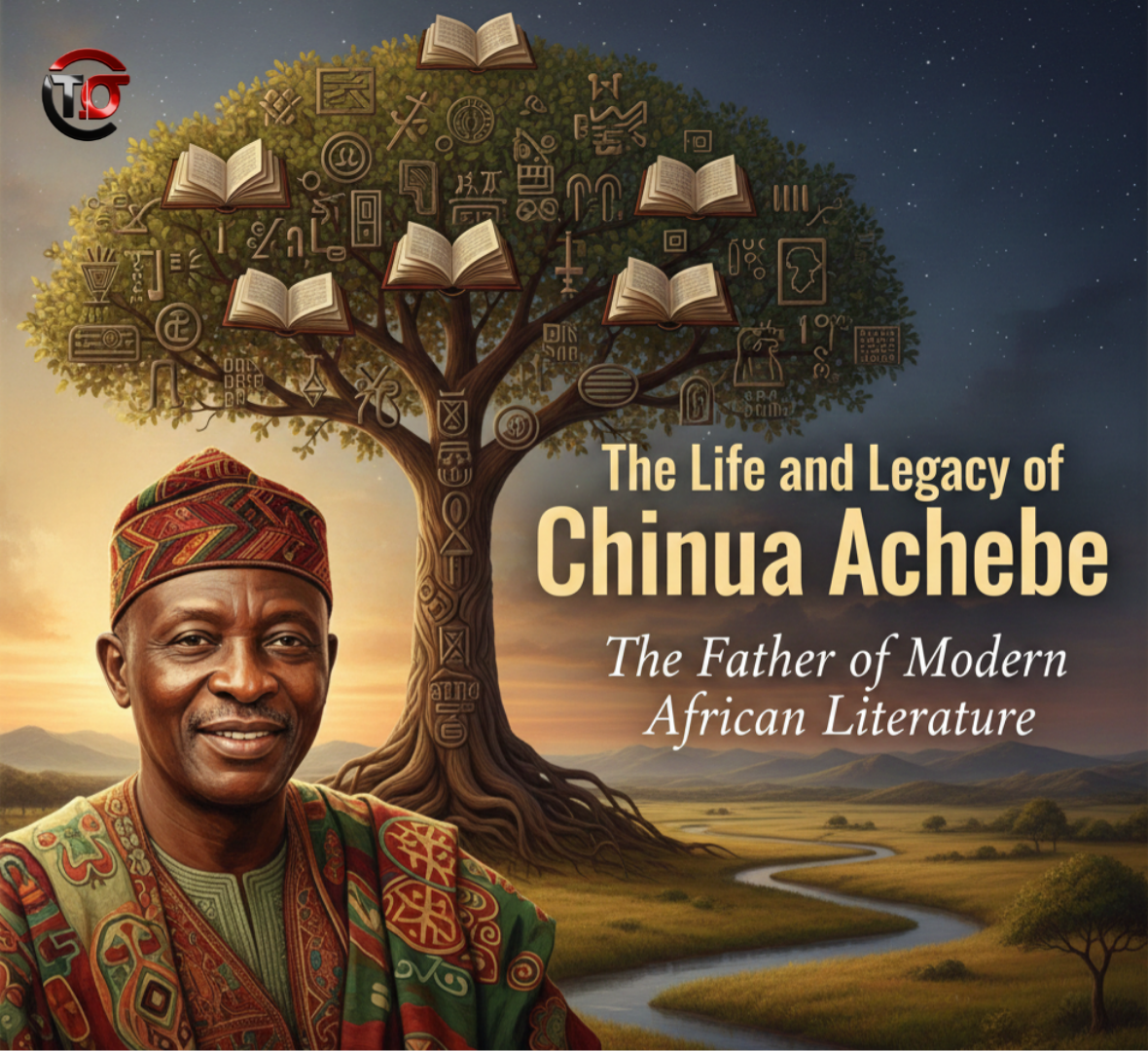
Chinua Achebe: Inspiring Biography of Nigeria’s Legendary Writer
Chinua Achebe is one of Nigeria’s greatest literary figures and one of the most influential writers in modern African history. His work transformed global understanding of African storytelling and reshaped how Africa is represented in world literature. Best known for his classic novel Things Fall Apart, Achebe used his voice to challenge colonial narratives and uplift African identity.
His life story is one of talent, courage, cultural pride, and unwavering commitment to truth.
Early Life and Family Background
Chinua Achebe was born on November 16, 1930, in Ogidi, a historic Igbo town located in present-day Anambra State. His parents, Isaiah and Janet Achebe, were early converts to Christianity and worked with the Church Missionary Society. Because of this, Achebe grew up at the intersection of two powerful worlds: traditional Igbo culture and Western Christian influences.
As a child, Achebe listened to folktales, proverbs, and oral histories shared by elders. These stories would later shape his writing style, helping him blend African traditions with modern literary techniques.
He was a brilliant student. His teachers noticed his deep curiosity, love for reading, and ability to analyze stories. These early influences prepared him for the extraordinary literary journey ahead.
Education and the Making of a Writer
Achebe attended Government College, Umuahia, one of the most prestigious schools in colonial Nigeria. Many Nigerian intellectuals and future leaders passed through this institution, and Achebe quickly distinguished himself as one of its brightest minds.
In 1948, he gained admission into University College, Ibadan (now University of Ibadan). He initially studied Medicine but soon discovered his real passion — literature. He switched to English and immersed himself in reading the works of European writers such as Shakespeare, Charles Dickens, and Joseph Conrad.
However, Achebe noticed something troubling: Africa was either invisible, misrepresented, or poorly described in Western literature. Some books portrayed Africans as inferior, uncivilized, or without history.
Achebe decided he would write stories that showed the truth about African societies — their beauty, their complexity, and their humanity.
The Birth of Things Fall Apart
In 1958, at just 28 years old, Achebe published Things Fall Apart.
The novel changed everything.
It told the story of Okonkwo, a respected Igbo warrior, and how colonialism disrupted traditional society. Achebe wrote with honesty, depth, and clarity. For the first time, global readers saw African life from an African perspective.
The book became:
- one of the most widely read novels in African history
- a classic in world literature
- a textbook in schools across Africa, Europe, and the Americas
- the foundation of modern African storytelling
Things Fall Apart has sold over 20 million copies and has been translated into more than 50 languages.
Achebe firmly established himself as the “Father of Modern African Literature.”
More Literary Works
After the success of Things Fall Apart, Achebe continued writing novels, essays, short stories, and children’s books.
Some of his other notable works include:
Novels
- No Longer at Ease
- Arrow of God
- A Man of the People
- Anthills of the Savannah
Essays & Nonfiction
- The Trouble with Nigeria
- Hopes and Impediments
- Home and Exile
His writings often explored:
- colonialism and its effects
- African identity
- corruption and political leadership
- culture and tradition
- power and morality
Achebe’s voice became a moral compass not just for Nigeria but for Africa as a whole.
Achebe as a Teacher and Cultural Ambassador
Achebe worked as a broadcaster, teacher, and professor in Nigeria and overseas. He lectured at universities in America, Europe, and Africa, carrying the African story with him everywhere he went.
He wasn’t just a writer — he was a cultural ambassador.
Through his storytelling and essays, he explained African history with dignity, challenged stereotypes, and encouraged younger writers to embrace their identity.
Writers such as Chimamanda Ngozi Adichie openly describe Achebe as their biggest inspiration.
Achebe and Nigeria’s Political Journey
Achebe lived through Nigeria’s independence, civil war, and political crises. He witnessed the rise and fall of governments, military coups, and the challenges of building a nation.
During the Nigerian Civil War (1967–1970), Achebe played an active role as a cultural representative for Biafra. After the war, he continued speaking against corruption and leadership failure. His book The Trouble with Nigeria boldly analyzed the root causes of the nation’s struggles.
Achebe believed that writers have a responsibility to tell the truth — even when it is uncomfortable.
Later Years and Final Works
Achebe suffered a car accident in 1990, which left him paralyzed from the waist down. Despite this, he continued writing, lecturing, and speaking about justice and identity.
In 2012, he published one of his most important later works, There Was a Country, a personal account of the Biafran War.
Achebe passed away on March 21, 2013, leaving behind a legacy that continues to shine.
Achebe’s Global Impact
Chinua Achebe became a global literary icon because:
- He restored Africa’s voice in world literature.
- He challenged colonial stereotypes.
- His stories blended tradition and modernity.
- He inspired generations of African writers.
- His novels remain timeless and relevant.
Today, Achebe is celebrated not only in Nigeria but across the globe. Universities study his works. Writers quote him. Students learn from him. His influence touches literature, culture, politics, and identity.
Life Lessons from Chinua Achebe
1. Tell Your Own Story
Achebe believed Africans should speak for themselves, not allow others to define their identity.
2. Literature Can Change Society
He used storytelling as a tool to educate, correct, and enlighten.
3. Culture Is Strength
Achebe preserved Igbo customs, proverbs, and values in his writing.
4. Courage Is Necessary for Truth
His political essays showed he was not afraid to challenge leaders.
5. Excellence Requires Discipline
Achebe’s success came from hard work, reading widely, and honoring his craft.
Why Achebe’s Biography Still Matters
In a world where cultures sometimes clash and misunderstandings rise, Achebe’s work reminds us of the importance of identity, truth, and dialogue. His life encourages young Africans to believe in their voice and tell their story confidently.
Achebe is more than a writer — he is a symbol of African pride.