


Have you ever dreamed of earning a respected British degree but felt held back by work, family, or the costs of relocating? If so, you are far from alone.
Every year on March 19th, the world observes the International Day of Digital Learning. For many, it is just another date on the calendar. But for millions of ambitious Nigerians, it represents a life-changing opportunity to break down the barriers of traditional education. This day highlights the potential of learning to transform not just individual lives, but entire communities through technology.
In 2026, the theme set by UNESCO is “Building digital futures for public education.” This is not just a slogan; it is a global commitment to answering a crucial question: Where are the digital spaces and resources to support public education online? The goal is to extend quality education into digital environments, making it accessible to everyone.
This guide will walk you through everything you need to know about this important day. We will explore the current state of digital learning in Nigeria, the real challenges you might face, and, most importantly, how you can seize this moment to advance your career through the Unicaf Scholarship Programme.
Let’s dive in and see how you can turn your educational dreams into a reality.
Part 1: Understanding the International Day of Digital Learning
To truly appreciate the value of this day, we need to go back to its origins. It is a relatively new celebration, but its impact is already being felt worldwide.
The History and Significance of March 19th
The International Day of Digital Learning was officially declared in November 2023 by UNESCO (the United Nations Educational, Scientific and Cultural Organization). During this session, UNESCO member states decided to proclaim March 19th of every year as the International Day for Digital Learning. The very first commemoration took place the following year, in 2024, marking a new era for global education.
This date reminds us that digital learning is no longer a luxury or a niche option. It is a necessity. UNESCO created this day to recognize the immense power of technology to address educational challenges and promote sustainable development across the globe. It is a call to action for governments, educational institutions, and private organizations to work together to close the digital divide.
2026 Theme: “Building Digital Futures for Public Education”
Each year, the celebration has a specific focus. In 2026, the theme is “Building digital futures for public education.”
So, what does that mean for you? It means that the global educational community is actively working to move public education into online spaces. It is about creating shared digital resources (often called “digital commons”) that allow everyone to access high-quality learning materials. The discussions this year will highlight how different countries are changing their education systems to include online environments, ensuring that no student is left behind due to a lack of physical infrastructure.
How Digital Learning Has Already Changed the World
Even before this official day was established, digital learning was reshaping education. It has broken down geographical barriers, allowing students in Lagos to learn alongside peers in London. It has made education more affordable and inclusive, enabling busy professionals and parents to earn degrees while managing their daily responsibilities.
From scalable e-learning platforms to the rise of Artificial Intelligence (AI) in classrooms, technology is making learning more personalized, engaging, and effective.
Part 2: The Current State of Digital Learning in Nigeria
Nigeria is at a pivotal moment in its educational journey. The hunger for learning is immense, but the path is filled with obstacles. Understanding these challenges is the first step to overcoming them.
The Digital Divide: Infrastructure and Access Issues
One of the biggest hurdles facing Nigerian students is the sheer lack of reliable infrastructure.
- 28 million children and adolescents in Nigeria lack access to any form of formal schooling or digital learning, a crisis exacerbated by insecurity, learning poverty, and a widening digital divide.
- Even at the university level, public institutions face severe digital infrastructure deficits, which block meaningful learning, especially in advanced fields like AI.
- Beyond hardware, accessibility challenges persist because many e-learning platforms are priced in foreign currencies and require high-speed internet, putting them out of reach for a large segment of the population.
- There are also significant disparities in digital access and training across different regions and institutions, following a north-south divide that often mirrors broader economic inequalities.
Affordability and Curriculum Gaps
Cost remains a primary barrier to higher education. The idea of studying abroad for a British degree can feel like a distant fantasy due to the sheer expense of tuition, travel, and living costs.
Furthermore, many critics argue that the traditional Nigerian curriculum does not always keep pace with the rapid changes in the global job market. There is a growing need for courses that teach practical, in-demand skills like data science, digital marketing, and project management.
Positive Trends: AI, EdTech Growth, and Government Action
Despite the challenges, there is a lot of hope. Nigeria is experiencing a digital learning revolution.
- Massive Digital Ecosystem: As of 2026, approximately 278 tertiary institutions across Nigeria have been onboarded onto the Blackboard digital learning platform, supporting over 2.2 million users (students, lecturers, and administrators). This places Nigeria among the largest and most ambitious digital learning ecosystems in the world.
- Rise of AI and Self-Learning: Google data shows a sharp increase in Nigerians using AI tools for self-driven education. Searches for learning languages, music, and creative skills have exploded, with AI learning surging by 84% in 2026 alone.
- Government Commitment: The Federal Government has set a bold mandate: by 2027, 70% of Nigerians must be digitally literate. To achieve this, the National Universities Commission (NUC) is developing a “Blueprint 2.0” (2026–2030) designed to drive ICT-enabled learning and modernize curricula across the Nigerian University System.
- EdTech Boom: Africa’s EdTech sector is witnessing significant growth, driven by rising smartphone penetration and a youthful population eager for accessible learning solutions. This is creating more options than ever before for Nigerian students.
Part 3: Introducing Unicaf – A Bridge to Global Education
In the midst of this changing landscape, one organization stands out as a powerful bridge between Nigerian ambition and global educational standards: Unicaf.
What is Unicaf and How Does It Work?
Unicaf is the leading online platform offering affordable, high-quality higher education to underserved markets. It achieves this by collaborating with reputable universities in the UK, US, Europe, and Africa. Through its network of partner universities, Unicaf offers bachelor’s, master’s, and doctoral degrees that are recognized internationally.
The model is simple yet revolutionary. Students can study online from anywhere, balancing their education with work and family. Unicaf provides the digital classroom, the learning materials, and the support, while partner universities provide the accreditation and academic rigor.
The Unicaf Scholarship Programme: How You Save Up to 75%
The most transformative aspect of Unicaf is its scholarship programme.
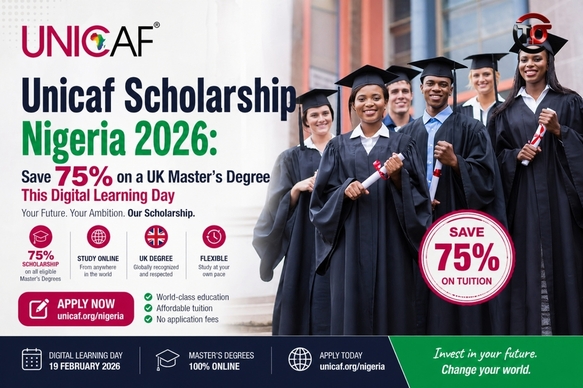
Education is expensive, but Unicaf believes that financial constraints should not be a barrier to a world-class education. Through its scholarship programme, Unicaf provides major tuition discounts that can save students up to 75% of their total fees.
In celebration of the International Day of Digital Learning, Unicaf is offering $1 million worth of scholarships. This is a limited-time opportunity to drastically reduce the cost of earning a British bachelor’s or master’s degree.
Partner Universities and Accredited Degrees
When you study with Unicaf, you are not getting a “lesser” online degree. You are earning a degree from a fully accredited, internationally recognized institution. Unicaf’s partners include prestigious universities such as:
- University of East London (UK)
- University of Suffolk (UK)
- Unicaf University
These partnerships mean that your degree carries the same weight and respect as a traditional on-campus degree, helping you stand out in the Nigerian and global job markets.
Part 4: Overcoming the Challenges of Digital Learning
Let’s be real. While digital learning offers incredible flexibility, it also requires a specific mindset and strategy. To truly succeed, you need to be proactive.
Creating a Dedicated Study Space (Even on a Budget)
You don’t need a fancy home office. You just need a quiet, consistent spot. It could be a corner of your living room, a local library, or even a quiet café. The key is to minimize distractions so you can focus on your work.
Mastering Time Management and Self-Discipline
Online learning gives you freedom, but that freedom comes with responsibility. Without a professor standing in front of you, you must hold yourself accountable.
- Create a schedule: Treat your online study time like a critical business meeting. Block out dedicated hours in your calendar each week to watch lectures and complete assignments.
- Set daily goals: Break down large tasks into smaller, manageable checklists. This helps you track progress and maintain motivation.
- Use proven techniques: Try the Pomodoro Method. Work in focused 25-minute intervals, followed by a 5-minute break. This prevents burnout and boosts productivity.
Staying Connected: Networking and Support Systems
One of the biggest fears about online learning is isolation. However, successful online students actively work to stay connected.
- Engage in discussion forums: Share your perspective and experience with other learners. This enhances the course topics and helps you build a valuable network.
- Communicate with instructors: Don’t be a stranger. Email your professors with questions or simply to introduce yourself. They are there to help you succeed.
- Find a study buddy: Connect with a classmate and hold each other accountable. A quick WhatsApp call or study session can make a huge difference.
Part 5: Real Career Outcomes for Online Degree Graduates
You are investing time and money into a degree. It is only natural to ask: “What kind of return will I see?” The data for online degree holders in Nigeria is encouraging.
Salary Expectations by Industry and Experience
Your earning potential depends on your industry, experience, and skill level. Here is a realistic breakdown of what you can expect:
| Level of Experience | Monthly Salary Range (₦) | Annual Salary Range (₦) |
|---|---|---|
| Entry Level | ₦120,000 – ₦250,000 | ₦1.44M – ₦3.0M |
| Mid Level | ₦500,000 – ₦1,500,000 | ₦6.0M – ₦18.0M |
| Senior Level (Local) | ₦3,000,000+ | ₦36.0M+ |
| Remote (International) | $1,500+ (~₦2.4M) | $18,000+ (~₦28.8M) |
- Entry Level: Graduates typically earn between N120,000 and N250,000 monthly. These roles are common in marketing, administration, customer support, and junior operations.
- Mid and Senior Level: As you gain experience, your salary scales significantly. Mid-level professionals in fields like tech can command N500,000 to N1,500,000, while senior engineers often exceed N3,000,000 monthly at Nigerian companies.
- Remote Work: This is where online degrees truly shine. The degree proves your ability to work in a digital environment, opening doors to international remote roles. Some remote tech placement programs guarantee starting salaries of $1,500 per month (approx. N2.4 million).
In-Demand Fields for Nigerian Professionals in 2026
Some sectors are growing faster than others. If you want to maximize your job prospects, consider pursuing a degree in these high-demand fields:
- Technology & AI: Data Science, Cybersecurity, and AI are exploding. Entry-level salaries range from N150,000–N400,000, with remote potential for much higher pay.
- Digital Marketing & E-commerce: As Nigerian businesses move online, they need experts in SEO, social media, and analytics.
- Project Management: Companies need organized professionals who can lead teams and deliver results.
- Finance & Accounting: This remains a stable career path, especially for those with certifications like ACCA or CIMA, which can be earned online.
- Law (LLM): A Master of Laws (LLM) from a UK university can open doors to specialized legal roles in corporate firms, NGOs, and international organizations.
Part 6: Step-by-Step Guide to Applying for a Unicaf Scholarship
Ready to take the leap? The application process is designed to be simple and straightforward.
Step 1: Complete the Online Application
The first step is to fill out the short online application form. You will provide your basic personal details, academic history, and choose your preferred programme. The form takes less than a minute to fill out.
You can start your application right here: Apply for the Unicaf Scholarship
Step 2: Connect with a Student Adviser
Once you submit the form, a dedicated student adviser will be assigned to you. They will reach out to assist you with the next steps, answer any questions you have, and guide you through the eligibility assessment.
Step 3: Submit Your Required Documents
You will need to prepare and submit your academic documents for verification. The standard requirements include:
- Academic certificates and official transcripts from all previous institutions.
- A valid form of identification (passport or national ID).
- An updated CV or résumé.
Step 4: Receive Your Scholarship Offer
The admissions team will review your file. If you meet the requirements, you will receive a scholarship offer detailing your tuition discount. You can then officially enroll and begin your journey toward a British degree.
Part 7: Real-Life Success Stories from Nigerian Students
Sometimes, the best validation is hearing from those who have walked the path before you.
Oti Jonathan Idowu
Oti chose Unicaf because it is an internationally recognized university that offered ease of study. The highlight of his experience was seeing his day-to-day business work directly reflected in the classroom environment, allowing him to apply learning immediately in real time.
Onyinye Mercy Agu
Onyinye, a graduate from Nigeria, spoke as a representative of the Unicaf University in Zambia Master’s degree graduates of 2022. She described it as a great honour and privilege, demonstrating how an online degree can lead to leadership and recognition.
Adedapo Adeniruju
From Ibadan, 27-year-old Adedapo won a full Unicaf scholarship for an online Master’s degree, including a laptop. His story shows that life-changing opportunities are within reach for dedicated Nigerian students.
These are not exceptions. They represent a growing community of professionals who have used digital learning to elevate their careers without sacrificing their jobs or relocating their families.
Conclusion: Your Digital Future Starts Today
The International Day of Digital Learning is more than a UNESCO commemoration. It is a global signal that the walls around education are coming down. For you, as a Nigerian professional or student, it is a signal that the world’s best education is now accessible from your living room.
You no longer have to choose between your career and your education. You no longer have to drain your savings to study abroad. Through digital learning and the Unicaf Scholarship Programme, you can earn a respected British degree, save up to 75% on tuition, and join a network of successful alumni across the continent.
The future of education is digital, and that future is open to you.
Do not let this opportunity pass you by. Take the first step toward the career you deserve.