


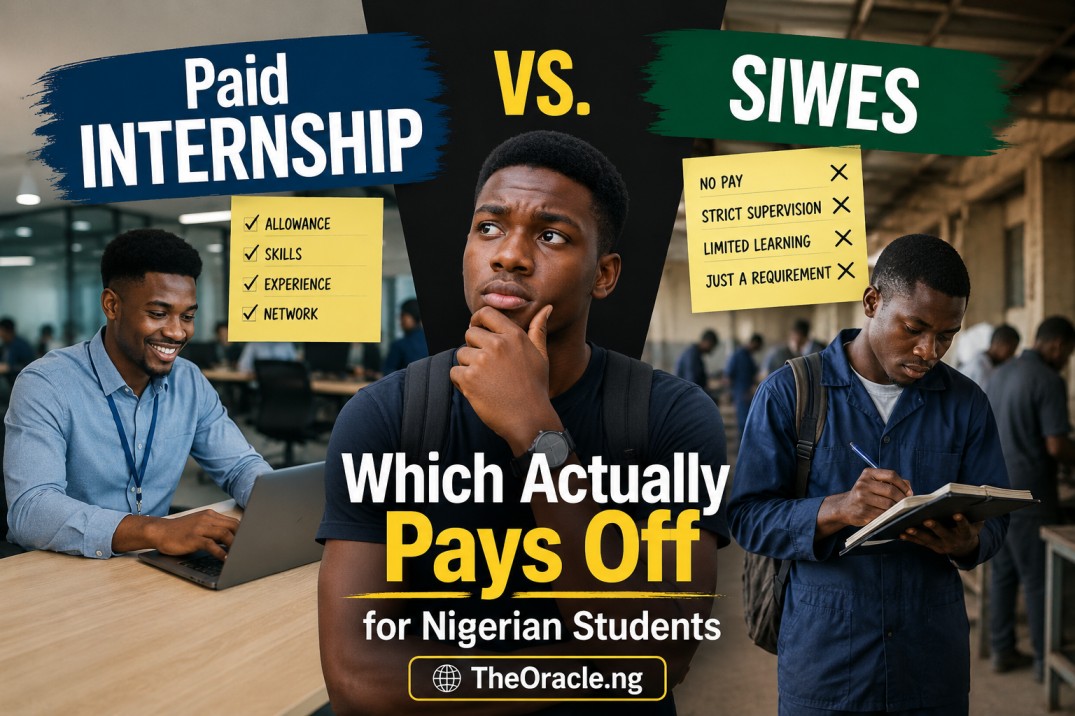

If you are a Nigerian student, you have probably faced the choice between a paid internship vs. SIWES. Both give you work experience, but the money you earn and the skills you gain can be very different.
The Students’ Industrial Work Experience Scheme (SIWES) is a government program that is compulsory for many courses in Nigeria. On the other hand, a paid internship is a job you find on your own where you earn a regular salary. So which one gives you a better return on your investment of time and energy? Let me break it down.
Measuring Your ROI in a Paid Internship vs. SIWES
To find out which option is better, you must look beyond just the money in your pocket. Your real ROI comes from three things: the skills you build, the people you meet, and the job you land after you graduate.
The Money Side
SIWES students may or may not get paid. The government’s Industrial Training Fund (ITF) sometimes pays a small allowance of about ₦15,000 for the entire six-month program, but this payment is often delayed for months or even years. Some private companies pay their SIWES students a monthly stipend, but many government offices pay nothing at all.
A paid internship is different. Companies like Shell and TotalEnergies pay their interns a regular monthly stipend. Some fintech companies even pay as much as ₦200,000 per month to their interns. The money can help you pay for transport, food, and other needs while you learn.
The Learning Experience
One major downside of SIWES is that the learning quality is not always good. Many studies show that SIWES is held back by poor supervision, weak ties between schools and companies, and a broken job placement process. Some students end up doing nothing useful for months.
Paid internships often give you real work to do because the company is investing money in you. You are more likely to work on actual projects, attend team meetings, and get feedback from a manager. This kind of experience is what employers want to see on your CV.
Which One Helps You Get a Job Faster
If you want to be hired quickly after school, a paid internship gives you a much better ROI. Here is why.
When you do a paid internship, you are building a direct relationship with an employer. Many companies use internships as a way to test and train future full-time staff. If you do good work, they may offer you a job before you even graduate.
With SIWES, the link to a real job is much weaker. The program was created to give you exposure, not necessarily to get you hired by the same company. Some students get lucky and their SIWES employer keeps them, but that is not the main goal of the program.
Here is a simple checklist to help you decide which path is right for you.
ROI Decision Checklist: SIWES or Paid Internship
- Ask your department: Is SIWES compulsory for your course? If yes, you must complete it to graduate.
- Check your finances: Can you afford to work for free or wait months for a small allowance? If not, a paid internship is better.
- Look at your industry: Tech, finance, and oil and gas companies pay well for interns. Creative fields may offer lower pay but better learning.
- Consider your goals: Do you want a job offer at the end? Prioritize paid internships with companies that hire their former interns.
- Time it right: Do your SIWES early if it is compulsory. Use your final year for a paid internship that can turn into a job offer.
Do not just pick one path. Many smart students do both. They complete their mandatory SIWES in their second or third year. Then in their final year, they find a paid internship that leads to a job offer.
A real-world example from my own circle: A friend of mine did his SIWES at a government parastatal. He showed up every day but did almost nothing for six months. He received no pay and learned very few practical skills. After graduation, he struggled to find a job because his CV had no real projects. He spent another year doing a paid internship at a tech startup. That second internship gave him the skills and network he needed to get hired full-time. The paid internship vs. SIWES comparison became clear for him – the paid internship gave the real ROI.
A limitation you should know: Not every paid internship is good. Some companies pay a small stipend but give you no real training. They just want cheap labor. You must research the company before you accept any offer.
To keep track of your work and prove what you learned, use the official ITF e-Logbook. You can access it through the ITF student portal. Find the link on the official Industrial Training Fund website. Keeping a good logbook helps you get your SIWES approved even if the learning was not great.
When weighing a paid internship vs. SIWES, remember that your time is valuable. Do not waste months on a program that teaches you nothing just because it is compulsory. Finish your SIWES requirements quickly, then chase paid internships that build your career.
Summary: If your course requires SIWES, complete it to graduate. But for real career growth and a job offer, focus on paid internships. They pay better, teach you more, and open doors that SIWES alone cannot.