


If you are looking for teaching jobs in Makoko’s low‑cost private schools, you have probably noticed that most online job boards do not list these positions. The schools exist, they need teachers every term, and they often hire quickly. But the way to apply is different from the formal government or international school process. This article shows you exactly how to find and apply for these roles without creating complaints from the Lagos State Government – complaints that can close a school or get you blacklisted.
Understanding the Makoko Teaching Landscape
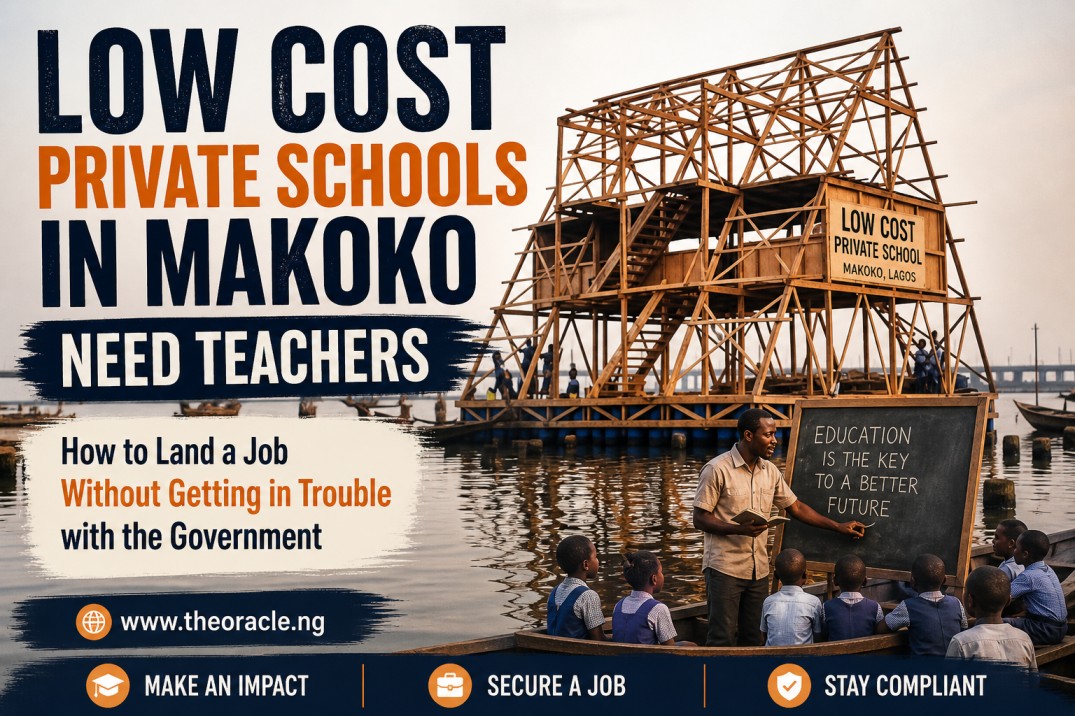
Makoko is a floating community on the Lagos Lagoon. Thousands of children live there, and most families cannot afford the extra fees of government schools. This is why low‑cost private schools in Makoko have multiplied over the last twenty years. Teachers in these schools often work in wooden classrooms on stilts with very few materials.
You need to understand the kind of school you are applying to. Some operate from a single room in a family home. Others have multiple classes in one space. Most are not fully approved by the government. The founder of Ken‑Ade Private School, Bawo Ayeseteminikan, started with just four children in a church premise and later gained international recognition for his work. The Shemede family runs three free schools across Makoko’s waterside, including Whanyinna Nursery and Primary School, which relies on volunteer teachers and donations. Knowing the type of school will help you target your application correctly.
Why Government Complaints Happen in the First Place
The Lagos State Office of Education Quality Assurance requires private schools to meet specific standards. These include having TRCN‑certified teachers, proper infrastructure, and approved curriculum delivery. When a school hires unqualified staff or does not follow safety rules, the government can issue complaints, fines, or even close the school.
A 2025 survey found that over eighty‑five percent of teachers in private schools were either not registered or could not be registered with the Teachers Registration Council of Nigeria. The government is now enforcing rules more strictly, and from 2027, secondary schools without qualified teachers will lose WAEC and NECO accreditation. This means that even low‑cost private schools in Makoko are under pressure to hire properly.
As a teacher, if you work in a school that later gets a government complaint, you could lose your job suddenly and find it hard to get another teaching role. Some schools may also withhold your salary if they are forced to close. So applying the right way protects both you and the school.
The Honest Reality About Low‑Cost Private School Salaries
Before you apply, you need to know what to expect financially. Many low‑cost private schools in Lagos pay between ₦25,000 and ₦50,000 per month for new teachers. A Guardian investigation found that some private school teachers earn as little as ₦15,000 monthly, even with over three years of experience. In some budget private schools, salaries range from ₦40,000 to ₦100,000, but many new teachers start at the lower end.
This is not a complaint about the salary. It is simply the reality. The schools themselves collect very low fees from families – sometimes as low as ₦3,000 per term. So they cannot pay what government schools or big private academies pay. If you go into this with your eyes open, you will not feel cheated later.
How to Apply for Teaching Jobs in Makoko’s Low‑Cost Private Schools Without Attracting Government Complaints
You can apply successfully and keep the government happy by following a quiet, respectful method. Do not walk into a school and ask loudly about their approval status. Do not post negative comments about the school on social media if you do not get hired. Here is the step‑by‑step process.
1: Walk or Boat to the Schools in Person
Most low‑cost schools in Makoko do not post jobs online. They hire by word‑of‑mouth or by seeing someone show up. Take a canoe from the Yaba side of Makoko to the waterfront. Wear simple, clean clothes – you do not need a suit. Bring copies of your credentials in a waterproof plastic folder because you will likely travel on water.
Approach the head teacher or proprietor directly. Introduce yourself and say you are available to teach. Be humble. Many founders of these schools started their work with very little. January Urban Wheduto, who runs Divine Nursery and Primary School, hires canoe operators just to bring pupils to school. He personally pays his teachers. Showing respect for what they have built goes a long way.
2: Show That You Can Teach Without Expensive Materials
Do not complain about the lack of whiteboards, textbooks, or chairs. Instead, show how you can teach with what is available. Carry one or two sample lesson plans you have prepared. If you have experience teaching phonics, basic math, or English without relying on printed materials, mention that.
Schools like Ken‑Ade Private School have operated for over three decades with corrugated tin roofs and limited space. The head of Whanyinna School, Noah Shemede, runs a floating school that teaches all subjects approved by the Lagos State Primary Curriculum, even without a permanent building. If you demonstrate that you can adapt, you become more valuable.
3: Clarify Whether You Have TRCN Registration
This is where most teachers get into trouble. If you are not registered with TRCN, do not lie. Schools that are trying to get government approval will check later. Instead, ask if the school requires TRCN certification immediately or if they will support you to register after hiring.
The good news is that the government has announced an amnesty programme for unqualified teachers, and TRCN has launched a digital teacher portal to streamline certification. You can register directly at the TRCN digital portal (tc.trcn.gov.ng) to begin the process. Some schools, especially those working with SEED Foundation, also provide training and support for teachers to meet government standards.
Be upfront. Say something like: “I am currently processing my TRCN registration. I can start while I complete it.” This is honest and gives the school owner a way to hire you without fear.
Actionable Checklist for Your Application
Use this checklist before you step into any school.
- I have printed at least 5 copies of my CV and credentials.
- My credentials are stored in a waterproof folder.
- I know the name of the head teacher or proprietor I want to see.
- I have prepared 2 sample lesson notes for subjects I can teach.
- I know whether I am TRCN registered or have started the process.
- I have researched the school’s fee range and understand the likely salary.
- I have set a realistic salary expectation (start at ₦30,000‑₦45,000 for entry level).
- I am ready to teach on a trial basis for one day if asked.
Real‑World Example – Learning from a Teacher Who Made It
I once worked with a young teacher named Adeola who wanted to teach in Makoko. She had a National Certificate in Education but no TRCN registration. Instead of applying online, she visited four schools in one morning. At the third school, the proprietor asked her to teach a class of thirty children without any textbook – just using the blackboard and her voice. Adeola taught a lesson on counting using stones she picked from the ground. That afternoon, she was hired. Within six months, the school helped her process her TRCN registration. Today she is still there, and the school has grown from fifty pupils to over two hundred.
The lesson is simple. In low‑cost private schools in Makoko, what you can actually do in a classroom matters more than your paper qualifications.
Short Application Letter You Can Adapt
Your Name
Your Phone Number
Your Address, Lagos
DateThe Head Teacher
[School Name]
Makoko Waterfront, Yaba, LagosApplication for Teaching Position
Dear Head Teacher,
I am writing to apply for a teaching role in your school. I hold [NCE / B.Ed / other qualification] and I am available to start immediately.
I can teach [subjects] and have experience managing classes with limited materials. I have attached two sample lesson notes for your review.
I am completing my TRCN registration and can provide proof within [timeframe]. I am willing to teach on a trial basis for one day so you can see my classroom management style.
Thank you for your time. I look forward to your response.
Yours sincerely,
[Your Name]
The Official App Link You Should Bookmark
The Lagos State Government’s Teaching Service Commission recruitment portal is a useful official source for teaching jobs. You can visit it at tescomjobs.lagosstate.gov.ng. While most low‑cost schools in Makoko do not advertise there, the portal will help you understand the official standards and requirements that government inspectors look for.
A Clear Downside of This Advice
Here is the honest limitation. Applying in person to unapproved schools carries a risk. If a school is later closed by the government, you may lose your job with no notice. The school may also not pay your full salary if financial problems arise. You will not have the same protections as a public school teacher. There is no pension, no health insurance, and no union to fight for you.
This method works best as a short‑term or mid‑term solution while you work toward full TRCN certification and look for more stable employment. Do not quit a better job to take a low‑cost private school role without careful thought.
How to Stay in the Government’s Good Graces While You Teach
Even if your school is not yet approved, you can still avoid personal complaints by doing the following.
Keep your own records. Write down every salary payment you receive. Take photos of your lesson notes. If the government ever questions the school, you can show that you acted professionally.
Complete your TRCN registration as fast as possible. You can do this without your employer’s help. Once you are certified, you become more valuable and harder to replace.
Do not accept illegal payment arrangements. Some schools may ask you to work off the books to avoid taxes. Politely refuse. It is better to earn less and be clean than to earn slightly more and risk a black mark.
Use the SEED Foundation training programmes. SEED Care & Support Foundation works with low‑cost private schools to train teachers and help them comply with Lagos State regulations. You can contact them for free or low‑cost training that will make you a preferred candidate for any school that wants government approval.
Side Opportunities That Can Boost Your Income
Because salaries are low, many teachers in Makoko’s low‑cost private schools also do private tutoring. After school hours, you can offer home lessons to children in nearby areas like Yaba or Sabo. Some teachers also sell revision materials they create themselves or start small teaching blogs. These side activities are not illegal, and they do not attract government complaints because they happen outside the school environment.
Legal Framework You Should Know
Nigeria introduced a National Policy on Non‑State Schools in 2025 to set standards for infrastructure, curriculum, and teacher qualifications in private and community schools. The Lagos OEQA now grades schools from A to D and is working to register at least 10,000 private schools by the end of 2025.
As a teacher, this means you should prioritise working with schools that are actively pursuing approval. These schools are less likely to attract government complaints. You can ask the proprietor directly: “Is the school registered with OEQA, and what grade has been assigned?” If they cannot answer, be cautious.
Short Summary
Teaching jobs in Makoko’s low‑cost private schools exist in large numbers, but you will not find them on job boards. You have to go to the waterfront, show your skills in person, and be honest about your TRCN status – that is how you get hired without attracting government complaints or putting your career at risk.