


No official document will fully prepare you for the shock of walking into a classroom that doesn’t look like a classroom. You see it for the first time: a dusty open space under a tree, a cramped church hall, or a single worn-out block with holes in the roof. That is the reality of serving as an NYSC Corps Member in an underground school.
When you get your posting letter to a place like Gindiri Schools in Plateau State, the address might look normal. But the school itself could be completely off the grid.
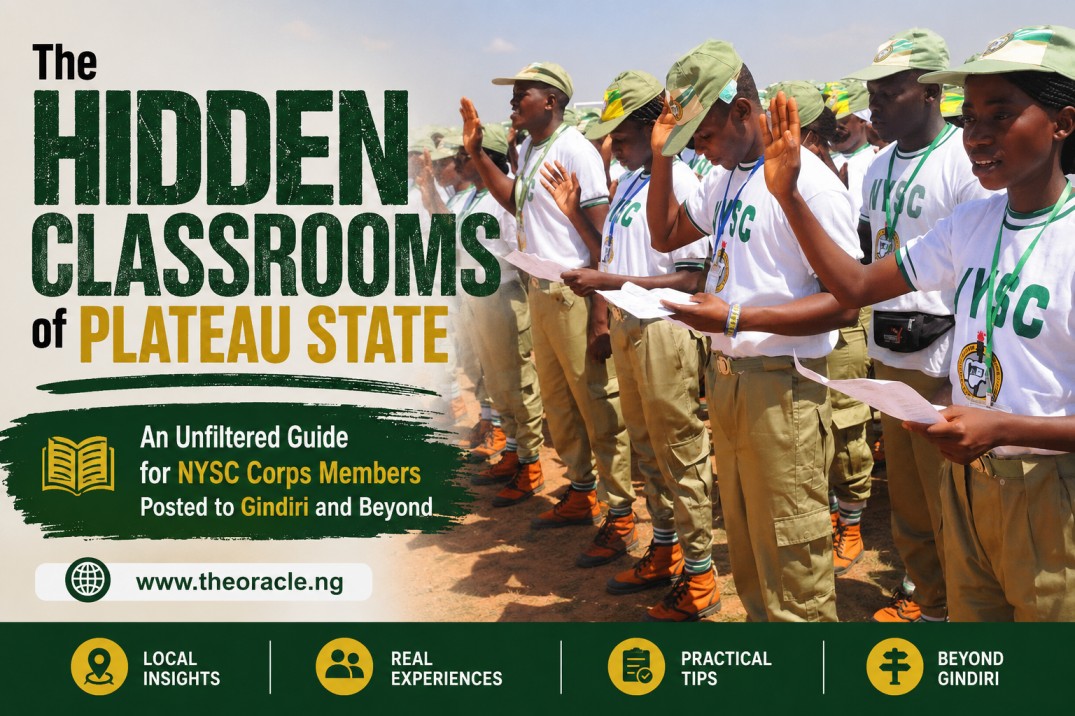
This guide is for the corps member who just opened their deployment letter and saw “Plateau State” — specifically the Mangu LGA area where Gindiri is located. I will show you exactly how to survive, teach effectively, and make your mark in these hidden classrooms. We will cover the real challenges (including the scary ones) and I will give you a practical strategy to turn a difficult situation into a transformative year of service.
The “Underground School” Survival Checklist (Do This Before You Leave Camp)
Before you leave the NYSC orientation camp in Mangu (which recently moved to a temporary facility in Jos South for security reasons), you need to gather specific items. NYSC officials announce camp relocation via the official NYSC mobile app. Do not forget to check the app for real-time updates on security protocols and posting details.
Here is a truthful checklist to help you prepare for the reality of underground schools. This is not a “packing light” list. This is a survival list.
- Heavy-Duty Power Bank: Electricity in the Mangu area is unreliable. You need this to keep your phone charged for emergencies.
- Portable Wi-Fi (MiFi): You cannot rely on GSM network data consistently. A MiFi often picks up slightly better signals than a phone.
- First-Aid Kit: Focus on anti-malaria drugs, oral rehydration salts (for typhoid from bad water), and bandages.
- Paper and Markers: Since you won’t have a printer or photocopier, large sheets of paper and thick markers are your only way to create visual learning aids.
- A Solid Padlock: Security is a concern. Padlock your room door and your closet. Do not leave valuables visible.
- Local Currency (Small Bills): Rural areas rarely have banks or ATMs that work. Bring enough cash to survive for at least six weeks.
- Rechargeable Fan: The heat in Mangu can be intense. A small USB fan is a lifesaver at night.
Answering Your Real Questions About Life as an NYSC Corps Member Serving in Underground Schools
You are probably worried. Let me answer the questions I know are running through your mind right now.
Where will I actually live?
In a place like Gindiri, your Place of Primary Assignment (PPA) might not provide housing. You will likely live in a rented room in a nearby village or sometimes in a small space behind the school building. Be prepared to negotiate rent with local landlords immediately upon arrival.
Will I get paid?
The NYSC federal allowance (allawee) is guaranteed for the 12 months. However, many underground schools lack funds for the extra “PPA allowance” that corps members in private schools receive. Do not budget for extra income from the school. Consider it a bonus if it comes.
Is it safe in Mangu LGA?
This is serious. The NYSC itself has acknowledged security threats in Plateau State. In 2025, the NYSC Coordinator in Plateau State specifically appealed to the Nigerian Army to intensify support for corps members due to security concerns. There have been tragic incidents, including the murder of a corps member in Pankshin LGA in early 2025 and kidnappings near Jos. You must register your presence with the local police and military posts immediately. Do not move alone after 6 PM.
What if the students don’t speak English?
Many children in Mangu LGA speak Hausa, Mwaghavul, or Berom as their first language. You will face a language barrier. Learn basic greeting phrases in the dominant local language within your first week to build trust quickly.
What do I do if there are no textbooks?
You become the textbook. Teaching in an underground school means you cannot rely on “chalk and talk.” You have to use real objects (leaves for biology, stones for counting) and your own voice. This is the hardest part of the job for most new corps members.
What “Underground School” Really Means for an NYSC Corps Member Serving in Underground Schools (And Why Gindiri?)
Let me clear up the term right away. When I say “underground school,” I am not talking about a bunker or a secret cave. I am referring to a school that exists without proper government recognition, standard infrastructure, or basic teaching materials.
These schools operate in the shadows of the formal education system. You might find them in a pastor’s compound, a community hall, or even under a large tree. A 2025 report by The Punch documented that in some Nigerian communities, children still receive their education entirely under trees or inside mosques due to a total lack of classrooms.
Similarly, an African Angle investigation revealed that in some rural settlements, students learn without books, classrooms, or any form of shelter. As an NYSC corps member serving in underground schools, you could very well be assigned to one of these unconventional sites.
The reality is that over 10.5 million children in Nigeria are currently out of school. Many are out because the schools near them simply don’t exist in a physical or functional form. Your role is not just to teach a subject. Your role is to help legitimize a hidden school and provide hope in an environment that has been abandoned by the system.
Why Gindiri? The Historical Context
You might be wondering why I keep mentioning Gindiri. Gindiri is a historic town in the Mangu Local Government Area of Plateau State. It is home to some of the oldest educational institutions in Northern Nigeria.
Boys’ Secondary School Gindiri was established in 1950 by missionaries from the Sudan United Mission. It was actually the fifth secondary school to be founded in all of Northern Nigeria. These mission schools were later complemented by Girls’ High School Gindiri (1958) and the Comprehensive College (formerly Teacher’s Training College). Together, they form the “Gindiri Compound Schools,” an initiative where students used farming to complement their learning.
However, despite this rich history, many of the surrounding feeder schools in the Mangu area have deteriorated. Security challenges and economic decline have hit Plateau State hard. This environment has created the perfect conditions for “underground schools” to flourish. They are the only option for displaced or impoverished children. That is why NYSC frequently deploys corps members to this specific corridor.
Creating a Classroom Out of Nothing: The S-E-E Formula for an NYSC Corps Member Serving in Underground Schools
You just got deployed. You walk into your underground school. There are 40 kids sitting on a concrete floor. No chalk. No board. No books. You have one month to prove you are effective, or the community will lose faith in the NYSC program.
Do not panic. Use the S-E-E Formula.
Step 1: Survey
Do not teach on Day 1. Spend 48 hours just walking around the community. Talk to the chief or the pastor running the school. Ask them: “What time do kids actually come?” and “What subject do parents want their kids to learn most?” If they say “English,” but you see the kids speaking Hausa, you know the real need is translation, not grammar.
Step 2: Extract Local Resources
Look at your physical environment. If you are in Gindiri, you are in the middle of a rocky, agricultural region. Use the rocks to teach counting (Math). Use the leaves of local plants to teach colors and shapes (Science). Use the local market receipts to teach literacy (English). Do not wait for the government to send you a projector.
Step 3: Execute Simple Lessons
Your lessons must be 15 minutes max for younger kids. Their attention spans are short, and they are likely hungry or tired from walking miles to get to the “underground” site. Focus on repetition. Clap your hands and chant the alphabet. Get them moving. A static teacher in a hot room loses the class immediately.
How an NYSC Corps Member Serving in Underground Schools Can Drive Real Impact (Without Spending Your Allowance)
Most corps members think impact is about building a library or drilling a borehole. Those are great, but it is unrealistic to expect a single NYSC corps member serving in underground schools to fund a massive infrastructure project. You have a monthly allowance of N33,000 (approximately). You cannot build a school with that.
Your true impact is people-driven.
Join the Education CDS Group
As soon as you get to your PPA, find the local NYSC Community Development Service (CDS) group. There is usually an Education CDS group specifically designed for those of you teaching in rural areas. These groups allow you to pool your resources.
Think about it: One corps member cannot buy textbooks for a class. But five corps members from five different underground schools in Mangu LGA can pool their allowances. You can buy a shared set of textbooks that rotate between schools every two weeks.
The Real-World “My Own Story” Moment
When I was serving in a rural part of the North Central region, I saw a fellow corps member, Blessing (not her real name), get posted to a school that had no windows. Just empty holes in the wall. For the first month, she cried every day. She told me, “There are 80 students here and only 2 working pens.”
She didn’t build a new school. Instead, she started a “Swap and Learn” program. She asked every student to bring one “texture” from home. One brought a rough stone. Another brought a smooth bottle cap. Another brought a soft piece of cloth.
Blessing used those textures to teach descriptive writing for a whole semester. Her students learned the words “rough,” “smooth,” and “soft” because they could touch the items. By the end of the year, her students were writing better sentences than kids in the town with full libraries. That is the power of working with what you have. You can do the same.
The Clear Downside of Serving in an Underground School (Read This Carefully)
I need to be honest with you about the emotional cost. The biggest downside of serving in an underground school is complete professional isolation.
You will likely be the only university graduate within a 10-kilometer radius. There are no staff meetings. There is no principal to guide you. You might be the only teacher for six grades at once. This means you will feel intense loneliness and frustration.
Furthermore, you have no legal protection if the school is truly “underground” (unregistered). If something goes wrong—a student gets hurt, a parent complains about curriculum—you are technically on your own. The NYSC will protect your life, but they cannot force an illegal school to follow labor laws.
You are serving at the pleasure of the community leader. If they decide they do not like you, you could be sent back to camp for redeployment with very little explanation. This is a major limitation of my advice: I am telling you to be creative and “make do,” but you cannot “make do” with a hostile administration or a dangerous security situation. If you feel physically unsafe, leave. Your life matters more than any classroom.
Leveraging Your CDS Project for Good in Gindiri
You need a Community Development Service (CDS) project that fits your reality as an NYSC corps member serving in underground schools. Do not try to build a block of classrooms. That requires ₦500,000 minimum. Here are three actionable, cheap projects that actually work for underground schools in Plateau.
Option 1: The “Clean Hands” Health Initiative
Most underground schools lack running water. Children get sick from dirty hands. A CDS project that teaches kids to make ash soap (cheap and local) and builds a simple “tippy tap” (a stick and a jerry can) for handwashing is highly valued. This costs under ₦5,000 and saves lives.
Option 2: The Mattress Mentorship Program
Many girls miss school because they lack sanitary pads. You cannot solve the Nigerian pad crisis alone. But you can organize a workshop where older female students learn to sew reusable pads from old cotton fabric (which is abundant in Gindiri markets). This keeps girls in class and teaches a trade.
Option 3: The Saturday Literacy Clinic
Underground schools often have terrible pass rates for basic literacy. Instead of extra classes after school (kids are too tired), hold a Saturday morning clinic from 9 AM to 11 AM. Use it solely for reading and writing games. Track how many students move from “non-reader” to “basic reader.” Present this data to the Local Government Education Authority at the end of your service to lobby for a proper teacher.
Navigating the Security Terrain in Plateau State “The 3 PM Rule”
You cannot serve effectively if you are dead or kidnapped. Let me give you specific security protocols for the Mangu/Gindiri axis that other blogs avoid because they are too scared to be specific.
The 3 PM Rule
In the later hours of the day, the risk of ambushes and attacks in Plateau State rises sharply. Make it a strict rule to finish all your community interactions and be inside your home or the NYSC lodge by 4 PM. Do not listen to locals who say “nothing will happen.” The stats don’t lie.
The Information Blackout
Do not post your daily location on social media. Do not tag “Gindiri, Plateau State” in a photo of you walking alone. Bandits and criminals monitor social media to track the movement of young, potentially valuable (for ransom) targets. You can post photos of your classroom after you have left the state, not during your service.
The “Safe House” Strategy
Establish one local “safe house” in your community. This should be the house of the village chief, the police post, or the oldest church/mosque building. Make sure the person in charge knows you by name. If you hear gunshots, you do not run into the bush. You run to the safe house. As an NYSC corps member serving in underground schools, your safety plan is more important than any lesson plan.
Summary
This guide has stripped away the romanticized version of NYSC teaching and shown you the harsh, rewarding reality of hidden classrooms. To be a successful NYSC corps member serving in underground schools in places like Gindiri, you must adapt, prioritize security, and turn local materials into learning tools—and if you do that, you will leave Plateau State with a resilience no city job can teach you.